
 Cognitive Health
 Stress & Mild Anxiety
 SFI Health News & Blog
 Liver Health & Detox
 Memory & Brain Health
 Sleep
Sleep Urinary Tract Health
 PMS & Cycle Regularity
 Early Childhood Learning
 Menopause
 Energy & Immune System


A Strength Based Approach for Early Childhood Learning with Dr Tony Lloyd
SFI Health was recently fortunate to be joined by the esteemed Dr Tony Lloyd, CEO of…

 Probiotics & Digestive Health
Plantago ovata and Senna tinnevelly plant are used to help support healthy, regular bowel movements.
Plantago ovata, more commonly known as Psyllium or Ispaghula, has a long history of helping with digestive complaints and Senna tinnevelly or Senna fruit, has a well-established use to help relieve constipation.
In Agiofibe and Agiolax, the husks and seeds of the Plantago ovata plant are used to help support and restore healthy, regular bowel movements.
Discover more about the balanced formulation used in Agiofibe and its combination with Senna in Agiolax and the key studies that support its benefits.

The seed husk of Plantago ovata has a long history of use as a dietary fibre supplement to promote the regular, healthy bowel movements and Senna tinnevelly fruit a well-established use to help relieve constipation.1,7,8
Psyllium is the common name used for several members of the plant genus Plantago, which contains over 200 species.2 Plantago ovata is extensively cultivated in Mediterranean and Asian countries.1
Ispaghula, the common name in India for Plantago ovata, comes from the Persian words “isap” and “ghol” that mean horse ear, which describes the shape of the seed.2
The Senna plant is indigenous to tropical Africa and also grows wild in the Arabian peninsula and India. The Senna pods (fruits) are rich in active compounds, known as sennosides – which have been shown to have a laxative effect. 1
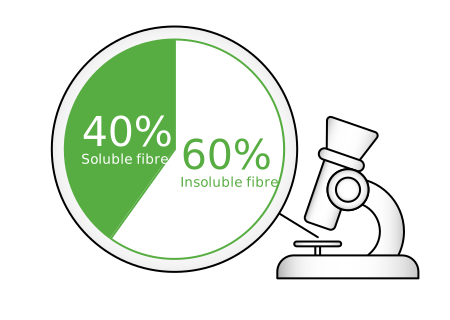
Agiolax and Agiofibe are made from a carefully balanced combination of insoluble and soluble fibre.
This optimal balance of insoluble and soluble fibres comes from using both the seeds and husks from the psyllium plant. Insoluble fibres are considered gut healthy fibres because they can have a laxative effect and add bulk to the diet helping with constipation.
Agiolax also contains Senna which can have a laxative effect. The senna pods are used as they provide a rich source of the active compounds, sennosides, primarily responsible for supporting regular bowel movements.3
Clinical studies show that Agiolax can actively relieve constipation, and help support regular bowel movements.3,5,6
They do this by increasing the content of both insoluble and soluble fibres in the gut. This can help increase the size and softness of the stools, and the frequency in which they are passed out of the bowel. 3
Constipation is when bowel movements become less regular and the stools can become harder and more difficult to pass. A normal bowel function is regular defecation with stools that are soft and easy to pass.
Constipation is very common with up to 30% of Australians experiencing this problem.4 One of the most common causes of constipation is not consuming enough suitable fibre in the diet. A normal healthy diet has a balance of both insoluble and soluble fibre.
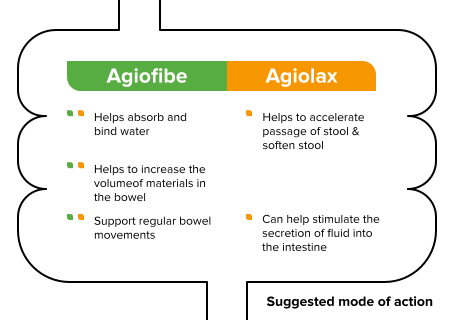
Agiolax and Agiofibe work by increasing the content of both insoluble and soluble fibres in the gut. This can help increase the size and softness of the stools, and the frequency in which they are passed out of the bowel. 3
Fibre and mucilage (a gummy substance secreted by some plants), from the seeds and husks of Psyllium absorb water, which can help increase the volume of material in the bowel. It is thought this then stimulates the ‘stretch reflex’ in the bowel which in turn can lead to propulsive movement, speeding up the transit of stools. The absorption of water also softens the faeces and provides a useful lubricating effect. 1
The Senna pods in Agiolax help to reinforce this bowel movement. Because the sennosides in the Senna pods are suggested to be activated by bacteria in the large intestine, it helps ensure the laxative action is predictable and gentle, and does not occur until it is required. It can then have a propulsive effect on the colon, accelerating their passage while softening the stools. It can also stimulate fluid secretion into the intestine, supporting the effect of the fibre in softening the stool.1
If you are not sure if Agiolax or Agiofibe is right for you, it is recommended to talk to your healthcare professional.
The combination of Psyllium and Senna in Agiolax has been researched demonstrating its beneficial effect in supporting healthy bowel function and relieving constipation.
These products may not be right for you. Read the warnings before purchase. These can be found in the dosage and directions sections of the product web pages. Follow the directions for use. If symptoms persist, worsen or change unexpectedly, talk to your health professional.
There may be several products on the market labelled as dietary fibre supplements. So what makes the Plantago ovata formulation in Agiolax and Agiofibe different?
Dietary fibre formulations can vary considerably depending on the proportions of insoluble and soluble fibre. The specific formulation used in Agiofibe and Agiolax is made predominantly from the seeds of the Psyllium plant, with a small amount of husk and a ratio of soluble to insoluble fibre that is similar to a normal varied diet.
Agiolax and Agiofibe are carefully prepared to ensure the final products are high quality with the optimal balance of ingredients, consistently reliable, batch after batch and based on research.
That means, you can be sure that the Agiolax and Agiofibe products you are getting contain the balance of fibre, processed in the precise way required to help support bowel health. That’s the SFI Health difference.

Rigorous processes, quality controls and extensive testing helps ensure that the products can provide the desired health outcomes demonstrated by evidence

Helps provide a carefully designed balance of fibres to help support bowel health

Evidence shows Agiolax can help relieve constipation and support bowel movement regularity 3,5,6
And used worldwide to support bowel health*
SFI Health was recently fortunate to be joined by the esteemed Dr Tony Lloyd, CEO of…

The variability in women’s perimenopausal experience and post-menopausal health status is significantly influenced by the type (natural versus induced) and timing of menopause onset. The average age of natural menopause onset occurs at 49-51 years of age, however there is an increasing prevalence of premature and early age menopause onset.

We make sure our natural medicines are consistent.
Not only do the clinical studies on our products demonstrate real health outcomes, they demonstrate the results you can expect from the same products you see on shelf. It’s all part of our Source to Patient philosophy.
*Prolonged use may cause serious bowel problems. Drink plenty of water. Do not use when abdominal pain, nausea or vomiting are present, or if you develop diarrhoea.